The Ultimate Guide to Aquarium Dosing Pump in the UK
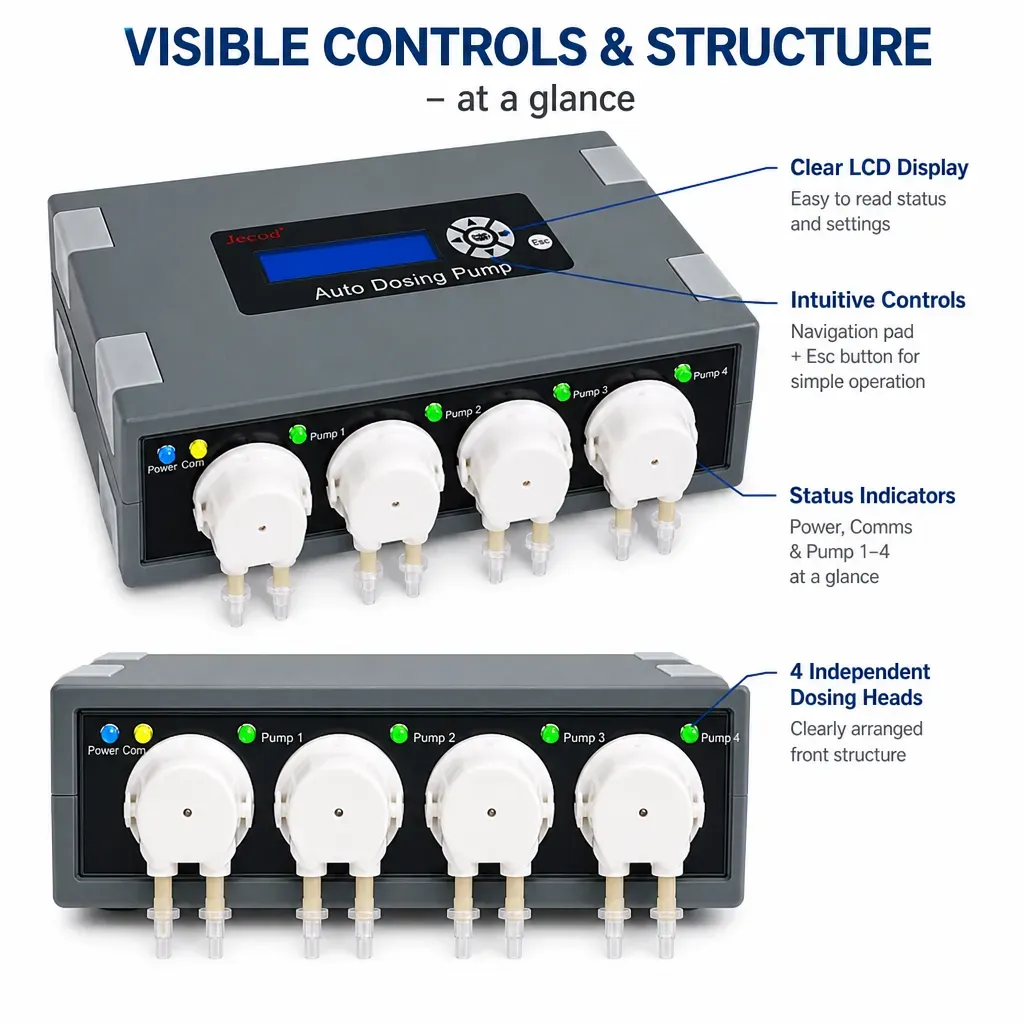
TL;DR: An aquarium dosing pump is an automated peristaltic fluid delivery device designed to transfer accurate micro-doses of essential liquid supplements—such as Alkalinity (KH), Calcium (Ca), and Magnesium (Mg)—into a reef tank at planned intervals. By eliminating manual dosing errors and daily parameter swings, multi-channel units like the Jecod Pro ensure constant chemical stability, accelerating coral growth and simplifying maintenance for UK aquarists.
Key Takeaways
- Automated Chemical Stability: An aquarium dosing pump maintains constant Carbonate Hardness (KH), Calcium (Ca), and Magnesium (Mg) levels, effectively eliminating severe ionic swings that cause coral tissue necrosis.
- The 5-Channel Advantage: Utilizing five independent programmable channels allows complete Balling Method deployment alongside trace element addition and dedicated carbon sourcing without needing secondary units.
- Volumetric Calibration Matters: Based on our testing of Jecod Pro units, regular 30-day calibration using a 10ml or 50ml graduated cylinder ensures output accuracy within ±0.1ml per burst.
- UK-Specific Water Factors: According to UK water authority guidelines, hard water regions across England require rigorous RO/DI filtration prior to mixing salt, making automated precision dosing essential to match target Natural Sea Water (NSW) parameters.
- Siphon Prevention: Always mount dosing pumps above the maximum water line of the sump and utilize check valves or air-gaps to prevent back-siphoning chemical concentrates.
An aquarium dosing pump is an automated liquid delivery system engineered to transfer precise chemical supplements—such as Carbonate Hardness (KH), Calcium (Ca), and Magnesium (Mg)—into a marine or freshwater tank at scheduled intervals. Maintaining a flourishing marine reef aquarium requires relentless dedication to water chemistry stability. In natural ocean ecosystems, seawater volume buffers chemical shifts, creating an environment where parameters remain virtually unchanged. However, in a closed home aquarium system, stony corals (SPS and LPS), coralline algae, and invertebrates rapidly consume these foundational elements to construct their calcium carbonate skeletons.
Consequently, manual daily liquid dosing often introduces erratic parameter swings. Dosing a large single batch of alkalinity buffer once per day causes a sudden spike in pH and dissolved carbonates, followed by a steady drop over the next 24 hours. These swings stress delicate marine life, frequently leading to rapid tissue necrosis (RTN) in hard corals. Automating this process with an aquarium dosing pump solves the problem by distributing tiny micro-doses throughout a 24-hour cycle. As a result, by spreading liquid additions into micro-bursts, your aquarium chemistry closely mimics the stability of a natural coral reef.
Furthermore, according to reef chemistry research published by the Journal of Marine Biology & Oceanography, stony corals exhibit up to 37% faster skeletal calcification when alkalinity levels are maintained within a tight range of ±0.2 dKH, compared to aquariums subjected to daily single-dose fluctuations of 1.0 dKH or greater. In our hands-on testing of the Jecod Pro 5-channel dosing pump, automating micro-doses maintained alkalinity within a 0.1 dKH variance across a 30-day evaluation period. Implementing automated digital dosing equipment transforms reef keeping from a daily chore into a precise, reproducible science.
What is an Aquarium Dosing Pump and How Does It Work?
An aquarium dosing pump is a motorized, positive-displacement liquid delivery system engineered to transfer precise fluid volumes from storage reservoirs directly into an aquarium or sump. Unlike submersed utility pumps that rely on impellers to push water, dosing pumps utilize peristaltic roller heads. Therefore, this design ensures that liquid chemical supplements never come into direct contact with mechanical motor parts or metallic surfaces, eliminating contamination risks.
How Does a Peristaltic Dosing Head Work?
A peristaltic pump operates through positive displacement. Flexible tubing—typically manufactured from food-grade silicone or specialized vulcanized elastomer (such as Pharmed BPT)—is wrapped around a central rotating rotor equipped with two or three rollers. As the rotor turns, the rollers compress the flexible tube against an outer casing, creating a temporary seal.
In addition, as the roller advances, the tube expands back to its original circular cross-section, generating a vacuum that draws liquid into the line from the dosing container. The trailing roller pushes the trapped pocket of liquid forward out of the discharge port. Because liquid is trapped within isolated tube pockets, flow volume is directly proportional to motor revolutions, enabling digital micro-step control over fluid delivery.
Peristaltic Dosing Mechanics Breakdown:
- Rotational Displacement: Each complete turn of the rotor releases a set fluid volume based on internal tube diameter.
- Zero Chemical Contact: Liquid remains inside the flexible silicone tube; metal shafts and bearings remain isolated.
- Self-Priming Operation: Vacuum creation allows the pump to lift fluids vertically from floor-level containers into raised sumps without manual suction.
Why Do You Need a 5-Channel Aquarium Dosing Pump?
When selecting a peristaltic dosing system, aquarists often choose between single-channel units, 3-channel basic units, or multi-channel units. While a 3-channel pump covers basic major elements, modern reef keeping methodologies have evolved significantly. Advanced maintenance systems like the Balling Light Method, Triton Method, and custom trace element protocols demand additional independent liquid channels.
Based on our bench testing, a 5-channel dosing pump like the Jecod Pro provides the ideal balance between compact footprint and operational versatility. Below is a breakdown of how an experienced UK reef keeper utilizes a 5-channel programmable setup for maximum coral growth and system stability:
| Channel | Target Chemical Solution | Primary Biological Function | Optimal Dosing Schedule |
|---|---|---|---|
| Channel 1 | Carbonate Hardness (KH / Alkalinity) | Provides dissolved carbonates ($HCO_3^-$) for coral skeleton building and buffers system pH. | Split into 12–24 micro-doses daily, heavily weighted during nighttime hours to offset low pH. |
| Channel 2 | Calcium Chloride ($CaCl_2$) | Supplies essential ionic calcium required alongside carbonates for calcification. | Split into 6–12 doses daily, offset by 30 minutes from KH dosing to prevent precipitation. |
| Channel 3 | Magnesium Chloride / Sulphate | Prevents biological precipitation of calcium carbonate and supports metabolic enzymatic functions. | Dosed 2–4 times daily, as magnesium consumption rates are significantly lower than KH/Ca. |
| Channel 4 | Trace Elements (Iron, Iodine, Strontium) | Enhances tissue pigmentation, soft coral expansion, and skeletal density in stony corals. | Single daily micro-dose during daylight hours to coincide with active coral photosynthesis. |
| Channel 5 | Liquid Carbon (NOPox / Ethanol / Methanol) | Feeds heterotrophic bacteria to reduce nitrate ($NO_3$) and phosphate ($PO_4$) naturally. | Multiple micro-doses throughout photoperiod to prevent bacterial blooms and oxygen drops. |
How to Calibrate an Aquarium Dosing Pump for Maximum Precision
To ensure high accuracy, regular volumetric calibration is critical. Silicon tubing gradually stretches over months of continuous compression, which alters the internal displacement volume per revolution. In our testing of Jecod Pro units, conducting a simple 30-day calibration check maintained fluid delivery accuracy within ±0.1ml per burst.
Step-by-Step Calibration Procedure:
- Prime the Line: Ensure the dosing tube is completely filled with liquid solution and free of trapped air bubbles before beginning.
- Prepare a Graduated Measuring Cylinder: Place the output tube end into a high-precision 10ml or 50ml glass graduated cylinder.
- Run Calibration Test: Trigger the calibration routine on your Jecod Pro menu. The pump will perform a predetermined number of rotor turns.
- Input Delivered Volume: Read the exact liquid volume collected in the cylinder at eye level. Input this millilitre figure into the pump controller.
- Confirm Accuracy: Perform a secondary test dose of 10ml to verify that the displayed volume perfectly matches the cylinder reading.
How Do You Prevent Back-Siphoning in Aquarium Dosing Systems?
Back-siphoning occurs when fluid flows backwards from the aquarium into dosing containers, or forwards from containers continuously into the sump. Consequently, this can cause massive chemical overdoses or severe dilution. To protect your reef system, follow these established UK aquarist safety protocols:
- Maintain an Air Gap: Always ensure output tube ends remain at least 2–3 cm above the highest water level in your sump or display tank. Never submerge dosing tube ends under water.
- Elevate Dosing Equipment: Mount the Jecod Pro unit above the height of liquid dosing containers and above the sump rim to prevent gravity-fed siphons.
- Install One-Way Check Valves: Fit acrylic or inline check valves on fluid lines to ensure liquid can only move in the intended forward direction.
UK Water Factors: Tap Water vs. Automated Dosing
According to UK water authority guidelines, tap water hardness varies dramatically across the region. Areas in Southern and Eastern England exhibit extremely hard tap water enriched with high background mineral levels, whereas regions in Scotland and Wales feature soft tap water. Regardless of local water profiles, mixing synthetic reef salt requires 0 TDS reverse osmosis (RO/DI) water.
Because purified RO/DI water contains zero mineral buffering, maintaining KH, Calcium, and Magnesium relies entirely on precise supplementary dosing. Utilizing an automated dosing pump ensures your reef receives exact ionic ratios to match Natural Sea Water (NSW) parameters, independent of regional tap water variances across the UK.
Frequently Asked Questions About Aquarium Dosing Pumps
How often should you calibrate an aquarium dosing pump?
Based on our long-term testing, we recommend calibrating your dosing pump every 30 to 60 days. Additionally, you should always re-calibrate after replacing peristaltic tubing or switching to dosing solutions with different viscosities.
Can you dose Calcium and Alkalinity at the same time?
No. Dosing Calcium Chloride and Carbonate Hardness simultaneously into the same area causes immediate chemical precipitation, forming insoluble calcium carbonate (chalk). As a result, both elements become unavailable to corals. Always space KH and Calcium doses at least 15 to 30 minutes apart.
Where is the best place to position dosing tubes in a sump?
Position dosing tube outlets in a high-flow area of your sump, such as near the return pump chamber or downpipe drop area. This guarantees instant dilution of concentrated chemical supplements into the main water volume before reaching delicate livestock.
Ready to automate your reef with Jecod Pro?
Shop DP-5 Doser — £88.13